The price you see in the Uber app at noon on a Tuesday is not the price you’ll pay the Wednesday before Thanksgiving. It’s not the price you’ll pay at 6 PM on a Friday in December, or the morning after a Chicago snowstorm backs up flight arrivals for six hours and then releases them all at once. Surge pricing at O’Hare is not random — it follows patterns, and those patterns line up almost perfectly with the moments when travelers are most dependent on a ride. Chicago O’Hare Limo Service is a limousine service providing flat-rate ground transportation from O’Hare International Airport and Midway Airport. Our professional chauffeurs quote a single price at booking and hold that price regardless of what the rideshare apps are doing when your flight lands. This piece covers how surge pricing works, which windows at ORD and MDW produce the worst multipliers, and how the cost math shifts once you run the numbers at 2x or 3x. See O’Hare airport transportation for service details and booking.
How Uber and Lyft Surge Pricing Actually Works
Surge pricing activates when the number of passengers requesting rides significantly outnumbers the drivers available to take them. Uber’s algorithm monitors both signals continuously and adjusts prices in real time. The core mechanic: when demand outpaces supply in a specific area, the app applies a surge adjustment to the base fare.
Uber uses three calculation methods depending on the location and ride type. The first is a multiplier applied to standard rates — a 2x surge doubles the base fare, per-mile rate, and per-minute rate simultaneously. The second is a flat fee added on top of normal pricing, displayed as an additional charge. The third is an upfront fare that already includes the surge component, so the rider sees a total price without the math broken out. In all three cases, Uber’s service fee percentage stays the same — the surge goes to the driver and platform. What changes is how much you pay.
The algorithm operates at a neighborhood or zone level, not city-wide. Two pickups a mile apart can see different prices at the same time. And because prices update continuously, a fare that looks reasonable when you open the app can be different by the time you confirm the booking — especially at high-traffic periods when conditions shift by the minute.
Why the Driver Always Wins During Surge — and You Pay for It
Surge pricing exists because drivers make a rational choice to avoid low-yield situations. At O’Hare, a driver entering the TNC lot can wait 20 to 45 minutes for their turn in the queue. That wait earns nothing. A driver working surge calls elsewhere during that window earns the multiplied fare on a trip they complete in the same time. The math favors the driver who avoids the airport queue.
The result is a structural supply shortage at ORD during any surge window. Fewer drivers are willing to wait, which means demand further exceeds supply, which raises the price further, which eventually draws drivers back — but only after the surge has already run for a while. This is the marketplace mechanism working exactly as designed. The surge is not a glitch. It is the algorithm’s deliberate correction mechanism for a supply-demand imbalance.
For passengers, the practical outcome is this: the rides you need most urgently — after a delayed flight, during a snowstorm, on the Wednesday before Thanksgiving — are the rides that cost the most, because those are the exact conditions that trigger the maximum supply shortage.
O’Hare Is Especially Prone to Surge — Here’s Why
O’Hare is one of the busiest airports in the United States and is routinely cited as among the most delay-prone. Both facts matter for surge pricing, and they interact in a specific way.
The first factor is volume. ORD processes millions of passengers across peak travel periods — over 1.8 million during Thanksgiving weekend 2024, and 3.66 million combined at ORD and Midway across the end-of-year holiday season (Chicago Department of Aviation, 2024). Large arrival waves produce compressed demand spikes — many passengers all needing rides at roughly the same time, from the same ground transportation zones.
The second factor is delay concentration. When a weather system grounds flights for several hours and then clears, ORD can see a compressed landing window — dozens of flights that were held all landing in a 90-minute period. Passengers from those backed-up flights all exit baggage claim and open their apps simultaneously. Surge that looks like it comes out of nowhere is frequently traceable to a weather event from hours earlier. One documented pattern: 3x surge at ORD on a day following a storm four hours prior — the storm is gone, but its effect on flight sequencing continues to play out in ground transportation demand.
The Surge Windows You Can Actually Predict at O’Hare
Some surge is structural and calendar-driven. These windows are reliable enough to plan around.
| Surge Window | Pattern | Typical Multiplier Range |
|---|---|---|
| Wednesday before Thanksgiving | Nationally the single worst travel day | Elevated; varies by hour |
| December 23–24 | Second-worst nationally; ORD processes millions | Elevated throughout peak hours |
| Monday 5–9 AM | Business traveler arrival wave | 1.5–2x during peak |
| Friday 4–8 PM | Business departure + Kennedy Expressway congestion | Frequently 2–4x |
| Post-event evenings | Following major Chicago events | 1.5–3x range |
| Weather surge | Snowstorms, heavy rain; compressed landing windows | 2–3x commonly reported |
The table above uses ranges because actual multipliers depend on the specific hour, the number of drivers who have positioned themselves in anticipation, and localized demand. Friday 4–8 PM is consistently cited as among the worst windows nationally for airport rideshare because rush-hour traffic on the Kennedy Expressway delays every vehicle, which extends per-minute fare charges on top of whatever surge multiplier is active.
Weather Surge at O’Hare: The 3x Nobody Saw Coming
Snowstorms produce the most dramatic surge events at ORD. Fewer drivers want to operate in icy conditions, while demand increases because passengers avoiding the train or bus switch to ride-hailing. Supply drops and demand rises simultaneously — the ideal conditions for maximum surge.
A documented example: a standard $15 ride that costs $42 under a 2.5x surge during a snowstorm. That’s an additional $27 on a trip most passengers expected to cost under $20. The storm doesn’t have to be happening at the moment you land. Delayed flight banks landing hours after a storm cleared still push demand into an undersupplied market — the ORD-specific pattern that catches travelers off guard.
Heavy rain without snow is sufficient to push multipliers to 1.5–2x in Chicago. Severe weather reroutes — passengers redirected from smaller regional airports to ORD — add an additional demand layer that doesn’t show up in any predictable schedule. And the core problem remains: you cannot cancel a delayed flight. You land when you land, into whatever surge conditions exist at that hour.
Chicago Event Surge: The Calendar That Costs You
Major Chicago events don’t cause surge pricing at O’Hare directly — but they affect the ground transportation ecosystem that ORD pickups travel through. Drivers chasing surge downtown are not in the ORD TNC lot. Post-event gridlock on the Kennedy Expressway slows every vehicle, adding per-minute charges to any rideshare fare.
Lollapalooza (Grant Park, typically late July or early August, approximately 100,000 daily attendees): surge after 10 PM is well-documented. Attendees are advised to leave 20 to 30 minutes before the last set ends to avoid the peak demand window.
Chicago Air & Water Show (lakefront, typically August): one of the largest free spectator events in the United States. Concentrated post-event departure produces a surge window that bleeds into broader city transportation demand.
Chicago Marathon (October, approximately 45,000 runners plus spectators): extensive road closures across the South Side and downtown complicate routing. Rideshare drivers face forced detours that increase trip duration and per-minute charges, compounding on top of any surge multiplier.
Bears games at Soldier Field (South Side): post-game demand spike in a constrained geographic corridor. Affects anyone routing south from the Loop toward ORD.
McCormick Place conventions (South Loop): large conventions generate sustained demand during peak session breaks. Convention pickups compete with general downtown rideshare supply, pulling drivers away from the ORD TNC lot.
Midway Airport Has Its Own Surge Problem
Chicago Midway (MDW) is a smaller airport with a different surge pattern than O’Hare, but the problem is equally real.
Southwest Airlines operates exclusively out of Midway in Chicago. That concentration means MDW departure schedules bunch by carrier — multiple Southwest flights departing in the same morning bank produce a demand spike before most rideshare drivers are active. The 4 AM to 6 AM window is structurally difficult for rideshare: driver supply is at its lowest of the day, demand is compressed, and the TNC staging area at MDW is smaller than ORD’s, limiting how many drivers can efficiently serve the queue.
The math is also more unforgiving on a shorter trip. MDW to the Loop is roughly 11 miles. A 2x surge on a $25 baseline fare doubles the cost on a trip many passengers assume will be modest. For Midway-specific flat-rate pickup, see Midway airport transportation.
How to Spot Surge Before You Confirm — and What to Do About It
Both Uber and Lyft display the upfront fare before the passenger confirms the booking. In Chicago, Transportation Network Provider ordinance requires that passengers be shown a fare quote before the trip begins and be given the option to decline. The price you see at the booking screen is the surge-included price. If it looks high, it is high.
Open both apps simultaneously. Uber and Lyft run independent algorithms. During surge, prices frequently diverge. Choosing the lower of the two at the moment of booking has been documented to save $25 to $40 on individual trips.
Use Uber Reserve for planned departures. Uber allows advance reservations up to 90 days ahead with a locked price. For a 6 AM Monday departure, booking the day before eliminates surge risk entirely. Lyft offers a similar scheduled-ride feature.
Wait 20 minutes after landing. For passengers with flexible schedules, waiting in baggage claim while the immediate post-arrival surge eases can reduce the multiplier. This works when the surge is short-lived and you have no time pressure. It fails completely for departing passengers, for travelers with meetings or connections, and during sustained holiday windows where demand may not ease for hours.
What a 1.5x Surge Actually Does to Your ORD Ride Cost
Surge multipliers apply to all variable components of the fare — the per-mile rate, the per-minute rate, and the base fare. A 2x surge does not mean $5 extra. It means the entire fare doubles.
Third-party fare aggregator data for the ORD-to-Loop corridor puts flat-rate professional car service in the $95–115 range for a sedan (this is a third-party estimate; see flat-rate Chicago limo pricing for current COLS rates). Rideshare at no-surge baseline may come in lower for the same trip. The calculus changes with any surge event.
| Rideshare Multiplier | Effect on a $75 Baseline Ride | vs. Flat-Rate Range (third-party est.) |
|---|---|---|
| 1.0x (no surge) | $75 | Below flat-rate floor |
| 1.5x | $112.50 | At or approaching flat-rate floor |
| 2.0x | $150 | Above flat-rate ceiling |
| 3.0x | $225 | More than double flat-rate |
The $75 baseline in this table is an illustrative example; actual Uber fares vary by time, traffic, and vehicle class. At 1.5x, a rideshare fare that started below the flat-rate alternative has crossed or is approaching that price. At 2x, it exceeds it. At 3x — a multiplier documented at ORD during weather events — the rideshare fare is substantially more expensive than the pre-booked alternative. The problem: you do not know which multiplier you will encounter when you book a flexible rideshare. You find out at the moment of pickup. For an ORD limo cost breakdown, see our pricing page.
The ORD to Naperville Problem: Surge Compounds on Longer Trips
The surge multiplication effect is most consequential on longer routes. ORD to Naperville is approximately 32 miles — a common route for business travelers headquartered in the western suburban corridor.
On a longer trip, both the per-mile and per-minute components of the fare are larger. A 2x surge on a baseline that is already elevated by distance produces a fare that can easily reach $150 to $175 on a route that a flat-rate professional service quotes at a fixed price. A 3x surge on a 32-mile suburban run does not produce the same dollar impact as a 3x surge on an 11-mile downtown run — it produces a substantially larger one. Business travelers routing through ORD to western suburbs — Naperville, Oak Brook, Schaumburg, Downers Grove — are among the travelers most affected by surge economics.
Four People, One Rideshare, and the Group Math Collapse
Surge pricing applies to the total fare regardless of how many passengers share the vehicle. An UberXL surge at 2x costs twice the UberXL baseline for four people. The group does not dilute the multiplier.
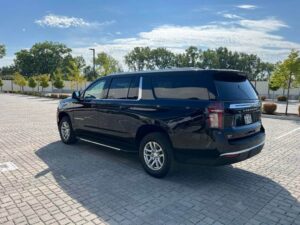
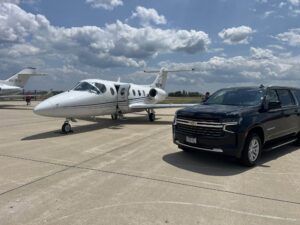
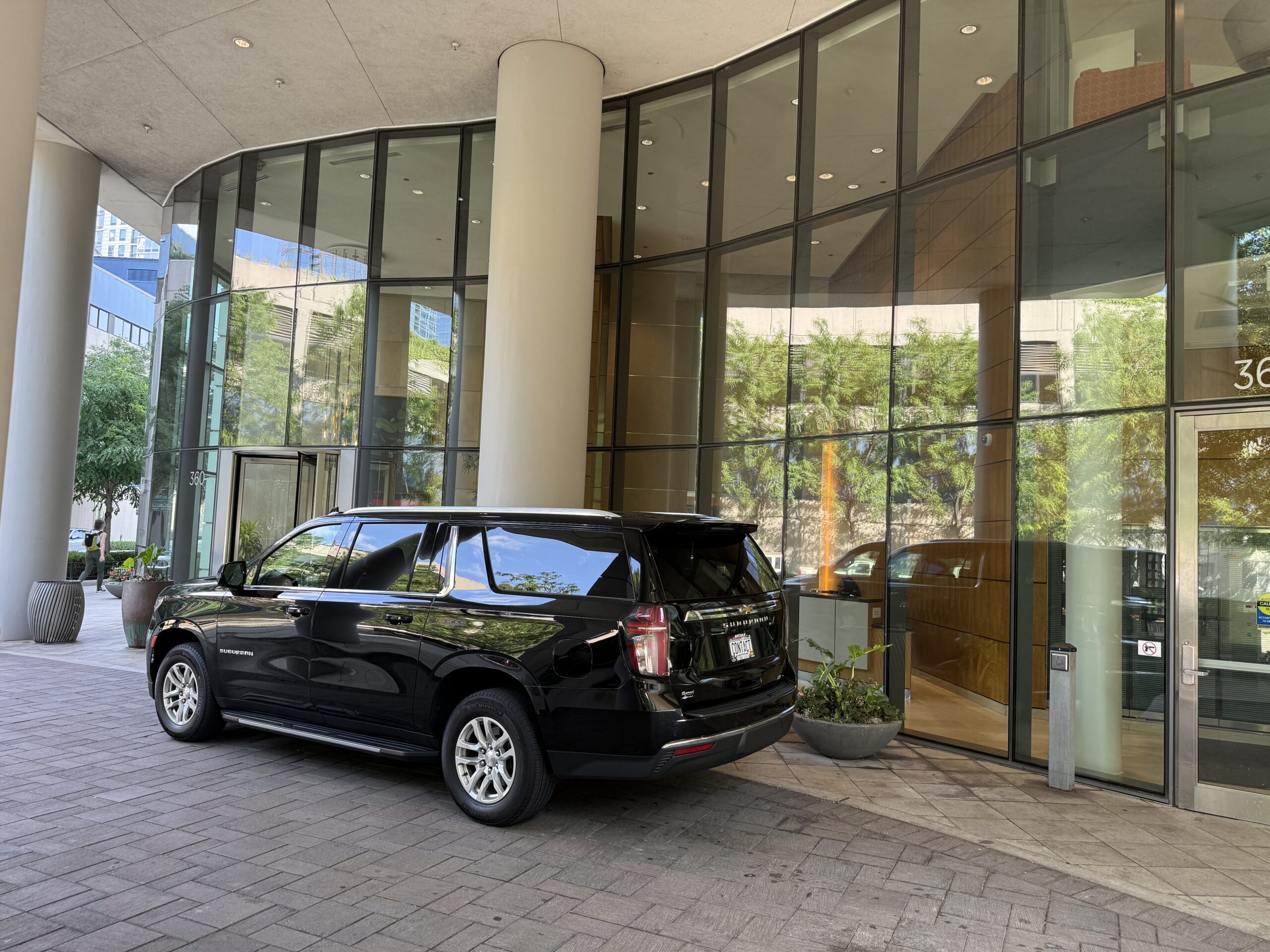
Consider four colleagues traveling together from ORD to a downtown hotel. At no-surge conditions, sharing a large rideshare vehicle offers a cost advantage. At 2x surge, that advantage narrows significantly. A professional SUV — the primary vehicle class in the Chicago O’Hare Limo Service fleet — accommodates four passengers at a single flat-rate quote. Third-party data puts group SUV professional service in the $125–145 range for ORD to downtown. At any surge above 1.5x with four passengers, the flat-rate SUV booking typically represents the lower total cost.
“Wait It Out” — The Strategy You Cannot Always Use
The “wait 20 minutes after landing” approach is real and sometimes effective. If surge is driven by a temporary demand spike, waiting can allow supply to catch up and drop the multiplier. Documented reports suggest waiting 15 to 20 minutes can reduce surge “a tier or two” at some airports.
This strategy works only when the passenger has no time constraint and the surge is short-lived — not driven by weather, ongoing holiday demand, or sustained event traffic. It does not work for any departing passenger, for business travelers whose itinerary begins at landing, or during sustained holiday peak windows where demand may not ease for hours.
Waiting for surge to drop and pre-booking a flat-rate service are not equivalent strategies. The flat-rate booking eliminates uncertainty at the moment of departure. The wait-it-out approach manages uncertainty after arrival with no guaranteed outcome.
Why Flat-Rate Limo Pricing Exists — and What Makes It Different
Commercial limousine and black car operators at O’Hare operate under a separate regulatory structure from TNPs (Transportation Network Providers). Rideshare companies like Uber and Lyft are licensed in Chicago under the TNP ordinance, which requires upfront price disclosure but permits dynamic pricing. Commercial vehicle operators — limousines, executive car services — hold separate permits from the Chicago Department of Aviation and operate under a different licensing tier.
When a professional Chicago chauffeur quotes a flat rate, that quote is a contractual commitment. There is no surge mechanism in the commercial vehicle contract. Weather does not change it. Demand spikes do not change it. Traffic on the Kennedy Expressway does not change it. Flight delays are managed within the standard pickup protocol — the chauffeur monitors your inbound flight and adjusts staging accordingly, holding the vehicle until the standard complimentary wait period has elapsed, at no additional charge.
This is the structural difference. TNPs give price visibility before the trip — you can see the surge and decide whether to pay it. Commercial operators give price certainty — the price does not change.
Black Cars vs. Rideshare at O’Hare: Where the Line Is
Uber Black and Lyft Lux are not the same category as a licensed commercial limousine. Both are Transportation Network Provider products — they operate under the same TNC licensing structure and the same dynamic pricing algorithm as UberX. A 2x surge on Uber Black is a 2x surge on an already-higher base rate. The vehicle may be a nicer car. The pricing behavior is identical.
The category distinction that matters is TNC (rideshare) versus commercial vehicle (limo/chauffeur). The former uses algorithm-driven surge pricing. The latter uses contractual flat-rate pricing. Uber Black is TNC. A licensed limousine with a CDA commercial vehicle permit is not. The staging zones, regulatory framework, and pricing commitment are all different. For a deeper comparison of how these services differ for Chicago airport travelers, see black car vs Uber Chicago.
When You Need Ground Transportation That Doesn’t Change Its Mind
A flight delay does not change a flat-rate quote. A snowstorm does not change it. A Friday evening traffic jam on the Kennedy does not add per-minute charges that were not in the booking. None of the conditions that drive rideshare surge apply to a pre-booked professional car service.
When you book a flat-rate ORD transportation pickup, the chauffeur receives your flight information and tracks the inbound aircraft in real time. If your flight is delayed, the chauffeur adjusts staging time accordingly — no calls, no rebooking. The standard pickup window includes complimentary wait time after wheels-down, covering the time it takes to clear customs, collect luggage, and reach the pickup zone.
For ORD pickup zones, staging locations, and the difference between the arrivals curb and the commercial vehicle zone, see O’Hare pickup zones. The comparison is not only about cost. It is about certainty at the moment when certainty has the highest value — a 5 AM departure pickup, a delayed arrival in December, the Wednesday before a holiday when every rideshare app in the airport is showing red.
Related Reading
- ORD ground transportation — pickup zones, terminal layout, commercial vehicle staging
- Black car vs rideshare Chicago — the regulatory and pricing differences explained
- Professional chauffeur flight tracking — how real-time flight monitoring affects your pickup