The O’Hare terminal guide most travelers find online tells you where the lounges and food courts are. This one tells you that and what a professional chauffeur watches for at each terminal — the pickup zone behind the terminal, the ATS train timing, and the difference between curbside arrivals and the commercial vehicle staging area that almost no traveler notices until they’re standing on the wrong curb. Chicago O’Hare International (ORD) is one of the busiest hubs in the world, and the way ground transportation works here is genuinely different from a smaller airport. Knowing how the terminals connect — and where your O’Hare airport transportation is actually allowed to stage — is the difference between a smooth pickup and a 20-minute hunt.
ORD at a Glance: Four Active Terminals, One Transit System
Chicago O’Hare currently operates four passenger terminals and one Airport Transit System (ATS) connecting them. Terminal 1 and Terminal 2 form the United Airlines complex on the north side. Terminal 3 is American Airlines’ hub plus a mix of Alaska, Spirit, and several international carriers. Terminal 5 is the international arrivals and customs facility on the east side, and it’s also the operating base for Delta, Frontier, and Southwest. The ATS runs a continuous loop between all four — it’s the only practical way to move between Terminal 5 and the others on foot.
For a professional ORD car service, those four terminals are four different operational scenarios. Domestic arrivals at T1, T2, or T3 stage one way. International arrivals at T5 stage another way, with a customs window built into the schedule. The ATS isn’t just a passenger convenience; it’s a timing input every chauffeur factors in. The terminal map below summarizes the airline-to-terminal mapping at a glance.
| Terminal | Primary airlines | Concourses | Notes |
|---|---|---|---|
| T1 | United mainline + international (Lufthansa, ANA) | B, C | Underground walkway + ATS connection |
| T2 | United Express, Air Canada, JetBlue | E, F | Slated for Global Terminal replacement |
| T3 | American Airlines (hub), Alaska, Spirit + international (Aer Lingus, BA, Iberia, JAL) | G, H, K, L | Largest physical footprint |
| T5 | Delta, Frontier, Southwest + international carriers | M | Customs and Border Protection (CBP) processing |
Terminal 1: United Mainline + Long-Haul International
Terminal 1 is United Airlines’ Chicago hub and houses Concourses B and C. Most United mainline domestic departures originate here, alongside long-haul international tenants — Lufthansa and All Nippon Airways are the headline carriers. Arrivals come down to the lower (baggage claim) level, where the standard arrivals curb sits directly outside.
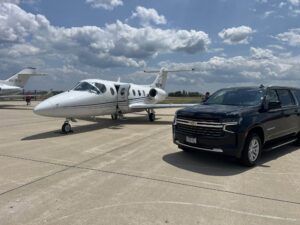
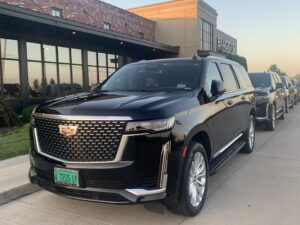
A pre-arranged black car at T1 doesn’t pick up at the standard arrivals curb. ORD designates a separate commercial vehicle pickup zone for licensed limo and car-service operators, and that’s where the chauffeur stages. The chauffeur watches the inbound flight on flight-tracking software, adjusts the staging window roughly eight to twelve minutes before bag drop, and coordinates with the passenger by text once luggage is in hand. The result: you walk to the commercial pickup zone, the vehicle is already there, and you don’t compete for curb space with the rideshare scrum.
Pickup zone vs curbside
The arrivals curb is for personal vehicles, taxis, and rideshare. Commercial vehicles — including any licensed limo or executive car — use a designated zone with separate signage. Travelers who haven’t used a chauffeured service before sometimes wait at the wrong curb. A confirmation text from the chauffeur clears that up.
Terminal 2: United Express + Regional Operations
Terminal 2 hosts United Express regional operations, Air Canada, and JetBlue out of Concourses E and F. It’s the smallest of the four active terminals and has the tightest baggage-claim footprint. That tight layout is actually useful for ground transportation: the walk from gate to bag claim to commercial pickup zone is short.
Two operational notes about T2. First, T2 is the terminal slated for replacement by the planned Global Terminal as part of the O’Hare 21 modernization program. Construction status is fluid — flights and pickups continue normally during the build. Second, because T2 baggage claim is compact, chauffeur staging timing runs tighter than at T1 or T3 — a 5-7 minute window rather than 8-12. A chauffeur who works ORD regularly knows this.
Terminal 3: American’s Hub + Alaska, Spirit, and International Tenants
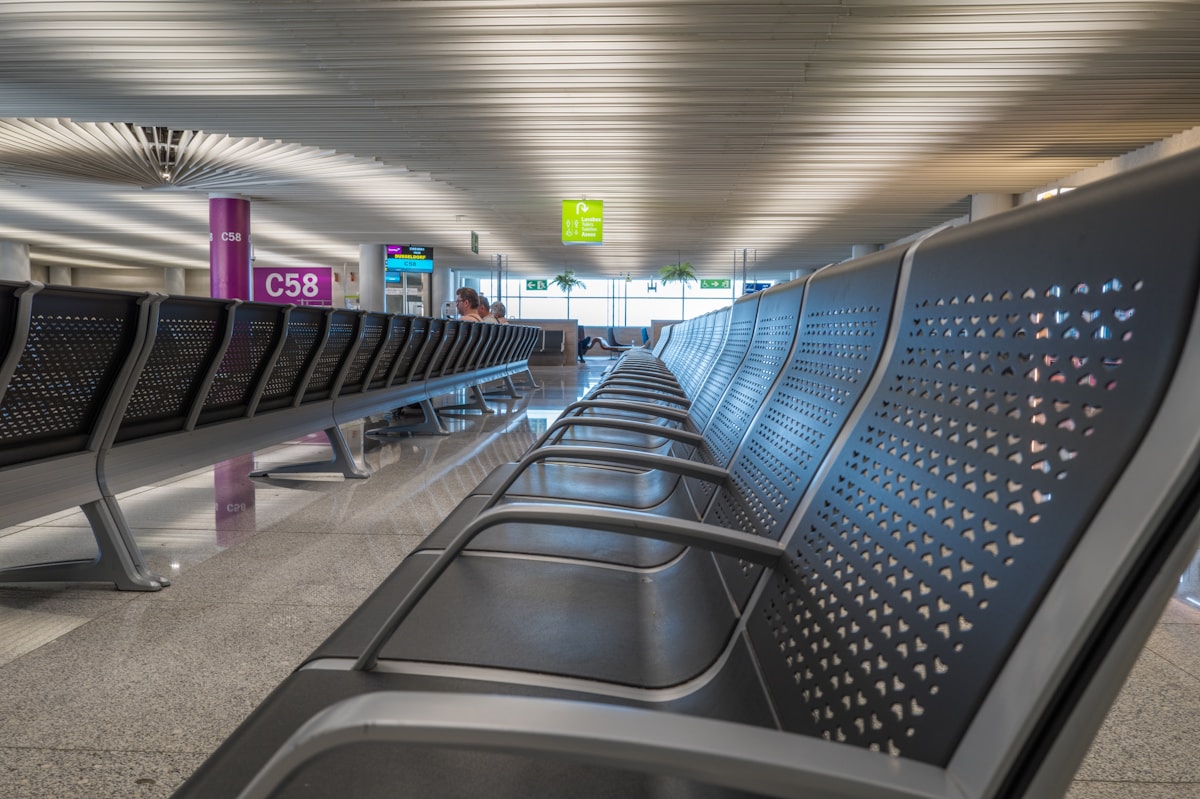
Terminal 3 is American Airlines’ Chicago hub and the largest of ORD’s terminals by physical footprint. It houses Concourses G, H, K, and L. Alaska Airlines and Spirit also operate domestic service from T3, and several international carriers — Aer Lingus, British Airways, Iberia, and Japan Airlines — base their Chicago operations here.
Concourse L is the longest walk in the terminal. From a gate at the far end of L to baggage claim runs around ten minutes for a passenger moving normally — longer with luggage or accessibility needs. That walk affects pickup timing: a chauffeur watching an inbound flight to a Concourse L gate adds those minutes to the staging window. T3 also has the deepest pool of curbside lanes, which means it’s the terminal most prone to the rideshare congestion problem during peak periods. The commercial vehicle zone is on a separate level — quieter, less stop-and-go.
Terminal 5: International Arrivals, Domestic Tenants + Customs Flow
Terminal 5 sits on the east side of ORD on Concourse M. It’s the international arrivals facility — most non-domestic flights process U.S. Customs here — but T5 has also become a domestic operating base for Delta, Frontier, and Southwest. The mix of domestic and international flights at T5 is a recent operational shift; passengers landing from a Delta domestic flight now arrive at the same terminal that processes a Qatar Airways arrival.
Two operational realities make T5 different from the other terminals. First, every arriving international passenger clears U.S. Customs and Border Protection (CBP) before reaching baggage claim. The CBP queue can run from a handful of minutes (low-traffic banks) to over an hour (peak international banks plus a backed-up queue). Second, T5 has a dedicated commercial vehicle pickup architecture connected to the Multimodal Facility (MMF) — a hub on the airport’s east side that houses rental cars, the ATS terminus, and the commercial vehicle staging zone for licensed services.
For a chauffeur, T5 timing isn’t a wheels-down calculation — it’s a wheels-down-plus-customs calculation. A typical international arrival runs 45 to 90 minutes from touchdown to commercial pickup zone curb, and the chauffeur monitors both the inbound flight and CBP queue conditions before staging.
Lounges by Terminal: Where to Wait Before Your Flight
Lounge access matters for two reasons: passenger comfort during connections, and pickup-window adjustments when an arriving passenger wants to use a lounge before exiting. ORD has lounges in every terminal, with the densest cluster at Terminal 5 because of the international banks.
- Terminal 1: United Club locations near gates B6, B18, and C10. United Polaris Lounge near gate C18 — Polaris serves United’s premium long-haul passengers and is the flagship lounge in this terminal.
- Terminal 2: United Club locations near gates E7 and F9.
- Terminal 3: American Airlines Admirals Club locations near gates G8, H6/K6, and L2A. The American Flagship Lounge sits between gates H6 and K6 — Flagship is American’s premium product for international and transcontinental first-class passengers.
- Terminal 5: Air France Lounge near gate M17, Delta Sky Club at gate M13, LOT Polish Business Class Lounge near the security/dining area, SAS Lounge near gates M19-20, and Swissport Lounge near gate M13.
For an outbound traveler with a chauffeured arrival, lounge access shifts the pickup math: the chauffeur drops you at departures, you clear security, and the pre-flight time is yours. For an inbound traveler with a connecting flight, a lounge in the connection terminal is worth a few extra ATS minutes.
Dining, Retail, and Currency Exchange
O’Hare’s dining and retail spread is large and continuously updated as concessions rotate. Every concourse has a mix of national chains, Chicago-specific brands (Garrett Popcorn, Lou Malnati’s, Rick Bayless’s Tortas Frontera presence at certain banks), and grab-and-go options. Currency exchange counters are present in every active terminal — Terminal 1 near gates B10 and C18, Terminal 2 near F1, Terminal 3 near K10, and Terminal 5 near M18 plus the lower level near door 5E. ATMs are available both inside and outside the secure areas of all terminals.
For business travelers, the practical note is timing: pre-security dining options at each terminal are limited compared to airside, so a chauffeured drop-off that includes time for a sit-down meal generally means clearing security first, then finding the airside concourse with the broader selection.
Family Amenities, USO, and Quiet Spaces
O’Hare publishes a substantial list of family-supportive amenities — important for parents with young children, military families using USO services, and travelers needing prayer or quiet spaces.
- Nursing rooms / mother’s rooms: Terminal 1 (gates B7, B10, C11, C23); Terminal 2 (E5, F9 crossover, E1, F1); Terminal 3 (near the yoga room, plus G12, K1, K5, K19, L6, L24); Terminal 5 (M20, M32, M37); also Multimodal Facility level 1.
- Family / unisex restrooms: Available in all terminals.
- USO lounges (active military and dependents): Terminal 2 mezzanine (pre-security), 9 a.m. to 9 p.m. daily. Terminal 3 Concourse G mezzanine, 9 a.m. to 5 p.m. daily.
- Multifaith chapel: Terminal 2 mezzanine, above the JetBlue and Alaska Airlines ticket counters.
- Yoga / wellness: A yoga room is located in Terminal 3 — a quiet space for stretching and meditation between flights.
Accessibility at ORD
O’Hare provides accessible parking, accessible shuttle service, and unisex family restrooms across every terminal. Over 200 accessible parking spaces are positioned near elevators and travel facilities. All shuttle buses to and from the airport parking lots lower to the curb for wheelchair access. For passengers with mobility needs, wheelchair assistance is requested through the airline at the time of booking — this routes a porter to the gate or curbside depending on the request.
Service-animal relief areas are located in every terminal, with multiple positions per terminal so a relief area is reachable from any concourse. International arrivals at T5 have a relief area in the sterile corridor (post-customs, pre-bag claim) and at baggage claim itself. Travelers using TSA Cares — TSA’s program for travelers with disabilities, medical conditions, or who need assistance through screening — should contact TSA Cares at least 72 hours before travel to coordinate. CLEAR and TSA PreCheck lanes are available at every terminal and frequently move faster than the standard line for passengers who qualify.
For chauffeured arrivals: the commercial vehicle pickup zones at every terminal are wheelchair-accessible, and a chauffeur can coordinate a curbside hand-off if a passenger has been escorted via wheelchair to the standard arrivals level.
Wi-Fi, Charging, and Connectivity
Free unlimited Wi-Fi is available throughout ORD — connect to _Free_ORD_Wi-Fi or the Boingo Hotspot. Charging stations are positioned at gates throughout each terminal: Terminal 1 (gates B5, B11, B12, B14, B19, C5, C15, C21, C28); Terminal 2 (gates E8, F2, F5); Terminal 3 (gates G13, G17, H12, K9, K12, L10B); Terminal 5 (gate M13). Most gate seating areas at recently refurbished concourses also include built-in USB and AC outlets.
Pet Relief Areas
Pet relief areas are present at every terminal — important for service animals and for travelers transiting with pets. Terminal 1 (lower level door 1A; across from gate K1; on the C concourse near C10); Terminal 2 (lower level door 2E); Terminal 3 (rotunda; across from K1; near L26); Terminal 5 (lower level door 5B; near M8; near M28; sterile corridor; baggage claim); Multimodal Facility (outside, roughly 50 steps from door 5B).
Getting Between Terminals: ATS, Walking, and Why Timing Matters
The Airport Transit System (ATS) is the people-mover train connecting T1, T2, T3, T5, and the Multimodal Facility. T1, T2, and T3 are also linked by underground walkways, which can be faster than waiting for the train during off-peak hours. T5 is only connected by the ATS — there’s no walking route from T5 to the other terminals. Professional chauffeur flight tracking uses ATS routing as one of its inputs: a passenger landing at T5 with a connection wouldn’t be the chauffeur’s concern, but a passenger who deplanes at the wrong concourse and uses the ATS to correct does affect when the chauffeur stages.
The ATS runs continuously and is free for all passengers. It’s accessible. It moves at airport-train speed — figure roughly seven minutes T1 to T5 station-to-station, plus walking time from gate to ATS platform on either end.
Ground Transportation Pickup Zones and Other Connections
ORD divides ground transportation into two distinct architectures. Arrivals curb is for personal vehicles, taxis, and rideshare; it’s the curb immediately outside baggage claim on the lower level of each terminal. Commercial vehicle zones are separate — designated by signage, accessed by a different roadway segment, and reserved for licensed limousine and executive car services.
The reason for the split is regulatory. Commercial vehicle operators at ORD hold a specific permit issued by the Chicago Department of Aviation. That permit grants access to the commercial pickup zones and obligates the operator to follow the airport’s commercial-vehicle operating rules. A rideshare driver does not have this permit and cannot use the commercial zones; conversely, a licensed limo cannot pick up at the standard arrivals curb in most circumstances.
For passengers, the practical effect is straightforward: a pre-arranged car service is staged at the commercial zone. A chauffeur sends a confirmation text once staged, and the passenger walks the short distance from baggage claim to that zone. Flat-rate ORD limo pricing applies — no surge, no metered upcharge for extra ATS minutes, no waiting-time clock during the standard arrivals window. The outer roadway around ORD’s commercial zones uses Bessie Coleman Drive for vehicle staging and circulation.
Beyond chauffeured car service, ORD connects to several public and shared transportation modes:
- CTA Blue Line: Terminus station at O’Hare on the lower level of the parking garage. Direct service to downtown Chicago, roughly 45 minutes to the Loop.
- Metra North Central Service: Transfer station at the northeast corner of the Multimodal Facility, weekday-only schedule.
- Rental car center: Multimodal Facility, accessible via ATS from any terminal.
- Hotel shuttles: Most off-airport hotels operate complimentary shuttles to the terminals, typically picking up at designated shuttle zones outside arrivals.
Hotels at and Near O’Hare
The on-airport option is the Hilton Chicago O’Hare, located between the terminal core and the parking garage. It’s the only hotel on airport property — connected via underground walkway, no shuttle required. Operated by Hilton Hotels under an agreement with the Chicago Department of Aviation.
Off-airport hotels cluster within two to three miles, primarily in Rosemont along River Road and Bryn Mawr Avenue. Premium options include the Hyatt Regency O’Hare Chicago (9300 W. Bryn Mawr Ave.), The Westin O’Hare (6100 N. River Rd.), and Loews Chicago O’Hare Hotel (5300 N. River Rd.). Mid-range options include Sheraton Suites Chicago O’Hare, Embassy Suites, and several Residence Inn locations in the Rosemont area. Most off-airport hotels operate shuttle service to the terminals, though shuttle frequency drops late at night — a pre-arranged car service is the more reliable option for early-morning departures or late-night arrivals.
Lost and Found, Safety, and Other Practical Notes
Lost-and-found at ORD is split by location. Items lost on the Airport Transit System: 773-462-0400 or lo**@******ts.com. Items lost in food-service areas: 773-377-7804. Items lost in parking: 773-686-7530. Items lost in terminal common areas (non-secure): Chicago Police at 773-686-2385. Items lost past security: TSA at tsa.gov/form/lost-and-found. Items lost in the Terminal 5 customs area: 773-686-3157.
What’s Changing: O’Hare 21 + the Global Terminal
The O’Hare 21 modernization program is a multi-year capital plan that includes the planned Global Terminal, which will replace the current Terminal 2 with a substantially expanded facility designed to handle both domestic and international flights under one roof. The construction timeline has been adjusted multiple times, so for current dates and milestones the official source is the Chicago Department of Aviation. While Global Terminal is under construction, all four current terminals continue to operate normally — passenger pickups, ATS service, and commercial vehicle zones are unaffected by the construction phases visible to travelers today.
For ground transportation, the Global Terminal will eventually shift the operational map: a single facility with mixed domestic/international flow changes how chauffeurs stage and monitor inbound flights. Travelers heading to the Milwaukee market today rather than ORD often choose Midway airport transfer as an alternative when the trip allows — a reasonable second-airport play depending on origin and schedule.