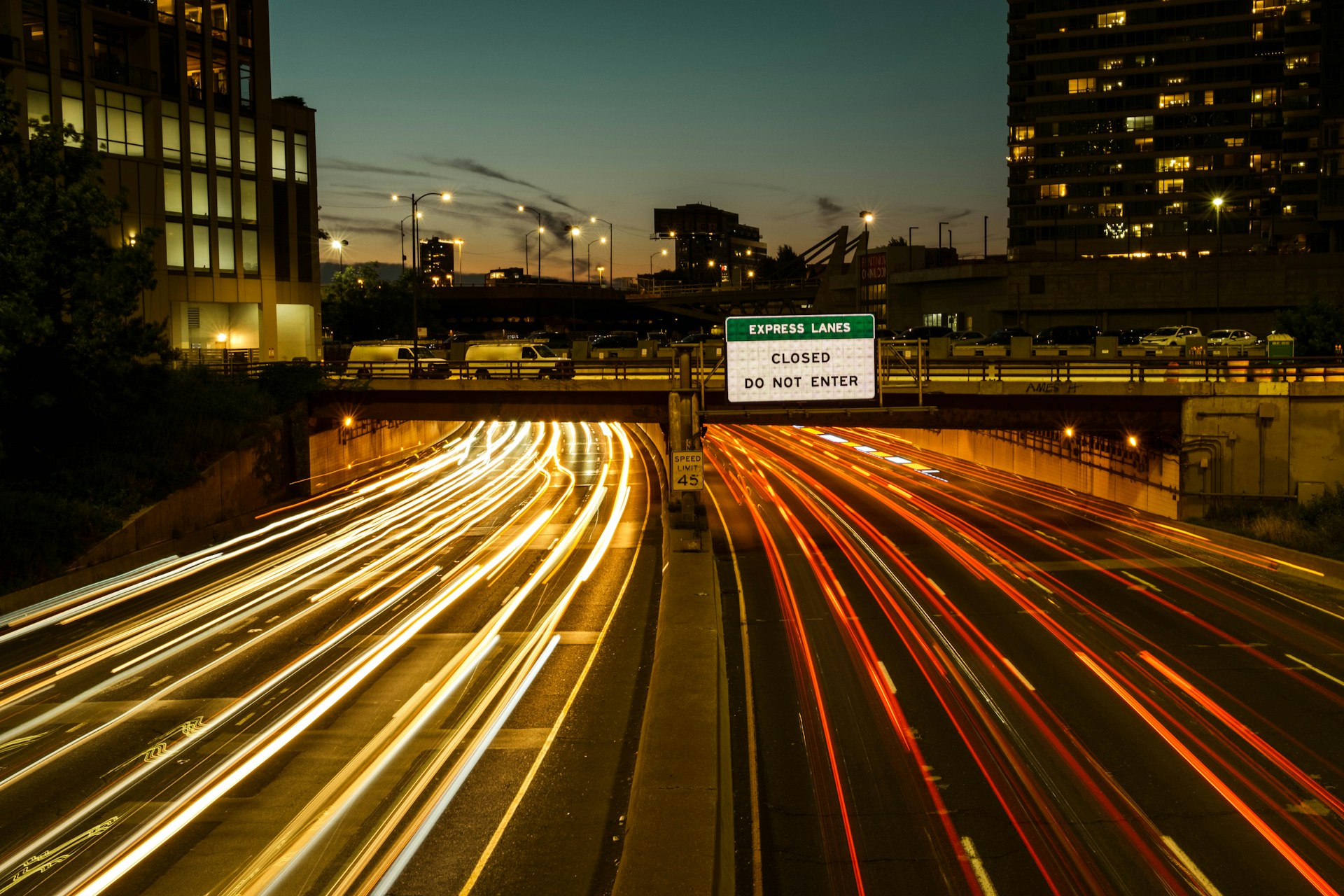
I-94 between Chicago and Milwaukee is one of the most traveled stretches of interstate in the Midwest — roughly 90 miles connecting two major cities through a dense lakeshore corridor that carries commuters, freight, business travelers, and leisure traffic every day of the week. The route is straightforward in concept and variable in practice. Weather, construction, sports events, and rush hour all reshape the experience depending on when you travel.
Chicago O’Hare Limo Service is a limousine service transporting passengers along the I-94 corridor between Chicago and Milwaukee — for corporate transfers, airport pickups at Mitchell International, and direct city-to-city travel. Our chauffeurs run this corridor regularly and navigate the conditions this road produces throughout the year.
This guide covers everything the corridor actually involves: distance and drive time, toll segments, speed limits, major landmarks, traffic patterns, construction status, weather, and how driving compares to the train and to a chauffeured car service for different kinds of trips.
I-94 Chicago to Milwaukee at a Glance: Distance, Drive Time, and Route
The drive from downtown Chicago to downtown Milwaukee via I-94 runs approximately 90 miles. Under light-traffic conditions — mid-morning on a weekday, or early on a weekend — the trip takes 90 minutes. In peak traffic conditions, expect 2 to 2.5 hours. On heavy Fridays between Memorial Day and Labor Day, the northbound run can push to 3 hours or more.
The route travels north from Chicago through suburban Cook County, picks up the Edens Expressway through Lake County, crosses the Wisconsin state line, and runs through Kenosha and Racine counties before hitting the Milwaukee metro and terminating at the downtown interchange cluster.
| Segment | Road Name | Tolls | Notes |
|---|---|---|---|
| Chicago city limits north | I-94 / Edens Expressway | Yes (IL Tollway) | William G. Edens Expressway; opened December 20, 1951 |
| Northwest suburbs to WI border | Tri-State Tollway (I-94 segment) | Yes (IL Tollway) | I-PASS and E-ZPass accepted |
| Wisconsin border to Kenosha | WI I-94 (free) | None | Toll-free; 70 mph posted |
| Kenosha to Racine | WI I-94 (free) | None | 70 mph; corridor midpoint |
| Racine to Oak Creek | WI I-94 (free) | None | Approaches Milwaukee metro |
| Oak Creek to downtown Milwaukee | WI I-94 (free) | None | Speed drops; Mitchell and Marquette Interchanges |
Toll Costs on the I-94 Corridor — What You’ll Pay in Illinois
Illinois tolls cover the northern portion of I-94 from the Chicago metro through Lake County to the Wisconsin border. The Tri-State Tollway operates this segment under the Illinois State Toll Highway Authority. An additional toll point — the Edens Spur — sits at the I-94/I-294 split in the Northbrook area.
Payment works in three ways on the Illinois Tollway:
- I-PASS (Illinois-issued transponder): processed automatically at posted I-PASS rates
- E-ZPass: accepted on all Illinois Tollway plazas — if you have an E-ZPass from another state, it works here
- Pay-By-Plate: if you have neither transponder, the tollway photographs your license plate and mails a bill at the standard rate
One important detail: most Illinois Tollway lanes no longer accept cash. Travelers without a transponder are billed by plate automatically. If you make this drive regularly, I-PASS or E-ZPass eliminates the billing friction and reduces the per-transaction cost. Once you cross into Wisconsin, tolls end completely. Wisconsin I-94 from the state line to Milwaukee is a free highway.
Major Exits and Landmarks Heading North from Chicago
The I-94 corridor north of Chicago passes through a dense chain of suburbs, a Lake County stretch that opens up slightly, and then the Wisconsin portion with a more rural character until the Milwaukee metro closes in again. Here is the corridor in sequence.
Edens Expressway and the I-294/I-190 interchange — The first major bottleneck for northbound travelers is the I-94/I-294/I-190 interchange where three major interstates converge and the branch toward O’Hare airport splits off. This is consistently one of the most congested nodes on the route, particularly in the morning rush as inbound ORD traffic mixes with northbound corridor traffic.
Highland Park and Lake Forest — These North Shore communities represent the densely suburban mid-section of the Illinois run. Traffic volumes remain high through this stretch but the pace is generally better than the interchange cluster.
Gurnee, Illinois (~40 miles from Chicago) — Gurnee is the major attraction hub on the corridor. Six Flags Great America, one of the largest amusement parks in the Midwest with attendance exceeding 3 million visitors in 2024, sits directly off I-94 at the Illinois Route 132 exit. Gurnee Mills mall is in the same exit cluster. Great Wolf Lodge, a 30-acre resort with an indoor waterpark, also operates here. Summer weekend afternoons through this stretch routinely slow because of theme park traffic.
Waukegan — Lake County’s largest city, 36 miles north of Chicago. US Route 41 runs parallel to I-94 here and is the primary local alternative if I-94 is closed or severely backed up.
Wisconsin state line — The Wisconsin Welcome Center sits on the northbound side immediately after crossing the border. Restrooms, maps, and visitor information. The toll road ends here.
Pleasant Prairie, Wisconsin (~50 miles from Chicago, ~40 miles from Milwaukee) — Pleasant Prairie Premium Outlets, operated by Simon Property Group, is located directly off I-94. The open-air mall has 88 stores across 402,524 square feet.
Kenosha, Wisconsin — Roughly 32 miles south of Milwaukee and 50 miles north of Chicago, Kenosha is the approximate midpoint of the Wisconsin leg. Mars Cheese Castle, at the Wisconsin Route 142 / I-94 junction, is a long-standing corridor landmark: a specialty food store, deli, and taproom selling Wisconsin cheese, sausage, beer, and wine. Wikipedia describes it as “an icon for generations of I-94 travelers.”
Racine, Wisconsin — 22 miles south of Milwaukee. Racine is known for the SC Johnson campus (Frank Lloyd Wright’s Johnson Wax Headquarters, architecture tours available) and its bakeries producing kringle — a Danish pastry for which Racine claims the title “Kringle Capital of America.”
Oak Creek, Wisconsin — The last municipality before Milwaukee’s southern city limits. Oak Creek borders Milwaukee Mitchell International Airport and is effectively part of the Milwaukee metro.
| Exit / Landmark | Approx. Miles from Chicago Loop | Notes |
|---|---|---|
| Edens / I-294 / I-190 merge | ~12 | ORD airport branch; primary congestion node |
| Highland Park / Lake Forest | ~28–32 | North Shore suburban stretch |
| Gurnee (Six Flags / Gurnee Mills) | ~40 | IL Route 132 / Grand Ave exit |
| Waukegan | ~36–38 | US-41 parallel alternative begins here |
| Wisconsin state line / Welcome Center | ~52 | Tolls end; northbound rest stop |
| Pleasant Prairie Premium Outlets | ~52–54 | Directly off I-94; Simon Premium brand |
| Kenosha / Mars Cheese Castle | ~58 | WI Route 142 exit |
| Racine | ~68 | WI Route 20 exit; SC Johnson campus |
| Oak Creek / Milwaukee Airport area | ~82 | MKE airport borders this city |
| Mitchell Interchange | ~85 | I-94 + I-41 + US-41 + I-43 + I-894 |
| Marquette Interchange (downtown Milwaukee) | ~90 | I-94 + I-43 + I-794; downtown gateway |
I-94 Speed Limits — Illinois vs Wisconsin
Speed limits on I-94 change as the corridor moves from dense suburban territory in Illinois to the more open Wisconsin highway. In Wisconsin, the DOT sets the following posted limits:
- Illinois border to the Waukesha-Milwaukee county line: 70 mph
- Milwaukee County, west of the Marquette Interchange: 55 mph
- Between the Marquette Interchange and the Airport Interchange: 50 mph (brief segment approaching the airport area)
In Illinois, the Edens/Tri-State segment carries suburban posted limits that vary by section. Expect 55–65 mph depending on the segment. The practical takeaway: once into Wisconsin, plan on 70 mph for the majority of the Wisconsin run, with a reduction to 55 mph and briefly 50 mph as you enter Milwaukee proper.
I-94 Traffic Patterns — When the Corridor Slows Down
The Chicago-Milwaukee corridor has predictable congestion patterns that recur week to week.
Chicago-end rush hour runs weekday mornings (7–9 AM) for southbound traffic into the city, and weekday afternoons (4–7 PM) for northbound traffic toward Milwaukee. The Edens/I-294/I-190 interchange is the focal point.
Milwaukee-end rush hour runs weekday mornings (7–9 AM) approaching downtown on I-94, and evenings (4:30–6:30 PM) on the outbound Milwaukee side. The Marquette Interchange is the focal point near downtown.
Friday afternoons from Memorial Day through Labor Day are the single worst traffic window on this corridor. Northbound I-94 from Chicago toward Milwaukee can add 45 to 90 minutes between approximately 2 PM and 8 PM.
Summer weekend afternoons slow through the Gurnee stretch because of Six Flags Great America traffic.
Milwaukee sports events at American Family Field (Brewers) and Fiserv Forum (Bucks) generate congestion before and after games on I-94 approaching Milwaukee.
Best travel windows: weekday 10 AM–2 PM; weekend mornings before 10 AM; any evening after 8 PM. Real-time routing: Waze and Google Maps both reroute dynamically. Wisconsin DOT’s 511wi.gov provides state-level condition updates.
Current I-94 Construction — What to Know Before You Drive
Wisconsin’s I-94 East-West construction project affects the Milwaukee approach — specifically the stretch near American Family Field. Travelers driving to Milwaukee Brewers games are directed to check brewers.com/traffic for construction-adjusted routing. General I-94 construction updates for Wisconsin are available at 511wi.gov or by calling 511.
Illinois DOT manages construction on the Tri-State/Edens segment; updates at gettingaroundillinois.com or via the Illinois 511 system. Construction windows change frequently — always check before any time-sensitive Chicago-Milwaukee trip.
I-94 Weather — Lake-Effect Snow, Summer Storms, and What Makes This Route Serious in Winter
The I-94 corridor sits within the Lake Michigan weather zone, and the lake is not a passive geographic feature for drivers.
Winter (November–March) is the primary concern. Lake-effect snow bands off Lake Michigan hit Kenosha and Racine counties with particular frequency — these cities sit in the lakeshore exposure zone, and lake-effect events can produce heavy localized snow with minimal warning. A trip that takes 90 minutes in July can take 3 hours or become inadvisable in a severe winter event.
Summer severe weather (May–September) brings fast-moving thunderstorms. Flash flooding at Chicago-area underpasses after an intense rainfall event can close sections of I-94.
Morning fog is a quieter hazard along the Kenosha and Racine stretch on calm, humid mornings — Lake Michigan fog reduces visibility on the highway in those counties.
COLS chauffeurs track road conditions on both the Illinois and Wisconsin segments, adjust departure windows for weather events, and apply experience with this specific route rather than relying solely on GPS-calculated travel time.
Rest Areas and Stops on I-94 Chicago to Milwaukee
This is not a remote corridor. Gas stations and convenience stores are accessible at virtually every exit through the suburban stretch from Chicago to the state line.
Wisconsin Welcome Center (northbound, at the Wisconsin state line): Restrooms, maps, and Wisconsin Tourism information. A standard rest break after the Illinois suburban stretch.
Pleasant Prairie Premium Outlets (Pleasant Prairie, WI — off I-94): Restrooms, food court, and 88 stores for a longer stop. Roughly 50 miles from Chicago and 40 from Milwaukee.
Mars Cheese Castle (Kenosha, WI — WI Route 142 exit off I-94): Full stop — cheese, sausage, deli, bakery, and an in-house taproom. Hours vary; verify at marscheese.com before planning your stop.
Six Flags Great America and Gurnee Mills — When Theme Park Traffic Hits I-94
Six Flags Great America is positioned at approximately 45 miles north of Chicago and 50 miles south of Milwaukee, with direct I-94 access at the Illinois Route 132 exit. Hurricane Harbor Chicago, its adjacent water park, operates on the same property. The park drew more than 3 million visitors in 2024.
Gurnee Mills mall and Great Wolf Lodge operate in the same general Gurnee exit cluster. If you are not stopping at Six Flags but driving through Gurnee on a summer Saturday afternoon, expect I-94 to slow in the Gurnee area. Departing before 10 AM or after 7 PM avoids the worst of it.
Pleasant Prairie Premium Outlets and Mars Cheese Castle — Two Stops Worth the Exit
Pleasant Prairie Premium Outlets (Simon Property Group) sits directly off I-94 and was built specifically to capture traffic from both markets. The outlet center contains 88 stores in 402,524 square feet of open-air retail space, developed in phases between 1988 and 1992 and substantially renovated in 2006.
Mars Cheese Castle at 2800 West Frontage Road in Kenosha occupies the WI-142/I-94 junction. The store sells Wisconsin cheese, sausage, beer, and wine, operates an in-store deli and bakery, and includes a taproom. For travelers in a Chicago to Milwaukee limo or car service: a chauffeured trip makes both stops easier — no parking to navigate, no concern about alcohol at the taproom before the rest of the drive.
Kenosha, Racine, and Oak Creek — The Mid-Corridor Cities
Kenosha sits roughly 32 miles south of Milwaukee and 50 miles north of Chicago — the approximate midpoint of the Wisconsin portion. For I-94 travelers, Kenosha is a practical stop point and the location of the Mars Cheese Castle at the WI-142 exit. Metra’s Union Pacific North Line connects downtown Kenosha to Chicago’s Ogilvie Transportation Center — a park-and-train option for Chicago-area residents.
Racine sits 22 miles south of Milwaukee and 60 miles from Chicago on the Lake Michigan shoreline. It is known on the I-94 corridor for the SC Johnson campus, where Frank Lloyd Wright designed the Johnson Wax Headquarters (open for architectural tours), and for its Danish heritage — it is called the Kringle Capital of America. Racine is accessed via the Wisconsin Route 20 exit, roughly 10–15 minutes from I-94.
Oak Creek is the last city before Milwaukee’s southern city limits. It shares a border with Milwaukee Mitchell International Airport and functions as part of the Milwaukee metro’s commercial edge.
Alternative Routes When I-94 Is Blocked
I-94 has two practical alternatives when the primary corridor is unavailable.
US Route 41 — the historic Skokie Highway in Illinois and US-41 in Wisconsin — runs roughly parallel to I-94 along the Lake Michigan shoreline through Waukegan, North Chicago, Zion (Illinois), and continues through Kenosha and Racine counties in Wisconsin. This is a surface road with stoplights, slower than I-94 in normal conditions, but a fully functional bypass during a closure.
I-294 Tri-State Tollway bypass — If congestion is concentrated at the Edens/I-294/I-190 interchange near Chicago, looping west via I-294 from the Northbrook area bypasses the interchange. It adds distance but eliminates the bottleneck. I-294 is also a tolled road.
Navigation apps (Waze, Google Maps) reroute in real time around reported accidents, construction, and closures. For any time-sensitive trip, running navigation from departure is practical regardless of route.
Amtrak Hiawatha — Chicago to Milwaukee by Train
The Amtrak Hiawatha is Amtrak’s seventh-busiest route in the United States, carrying 636,854 passengers in fiscal year 2023. It operates the 86-mile rail corridor between Chicago and Milwaukee in partnership with the Illinois and Wisconsin Departments of Transportation, running on CPKC Railway tracks and Metra’s Milwaukee District North Line.
Stations: Chicago Union Station → Glenview (Illinois) → Sturtevant (Wisconsin) → Milwaukee Airport Rail Station → Milwaukee Intermodal Station
Travel time: approximately 90 minutes | Frequency: 6 round trips per day (5 on Sundays); 12–14 total trains per day
The case for the train: Chicago Union Station to Milwaukee Intermodal is a downtown-to-downtown service with no driving, no parking, and no tolls. On a weekday morning when I-94 north from Chicago is congested, the Hiawatha’s 90-minute travel time is competitive.
The case against the train for some trips: Fixed schedule — there is no 2 AM train, and if you miss the last train you are not riding the Hiawatha. Baggage is limited compared to a vehicle. The 90-minute travel time does not include ground transportation at either end. For business travelers with equipment, groups, or end-points off the downtown core, it is less competitive.
Flying into Milwaukee Mitchell International (MKE) vs Driving I-94
Milwaukee Mitchell International Airport (IATA: MKE) is located 5.8 miles south of downtown Milwaukee, accessible via the I-41/I-94 Mitchell Interchange. Southwest Airlines operates 40.8% of the airport’s traffic; Delta, American, United, Frontier, Alaska, JetBlue, and Sun Country also serve MKE.
The key point for Chicago travelers: No commercial airline operates a direct flight between Chicago O’Hare (ORD) or Chicago Midway (MDW) and Milwaukee Mitchell (MKE). The cities are 90 miles apart. For this origin-destination pair, driving and the Hiawatha train are the only options.
When MKE is the right airport: If your origin city is not Chicago — flying from Dallas, Denver, or New York for a Milwaukee meeting — MKE is worth comparing to ORD. MKE sits 15 to 20 minutes from downtown Milwaukee by car, versus 40 or more minutes from ORD.
MKE ground transport to Chicago: Badger Coaches and Wisconsin Coach Lines operate scheduled bus service from MKE to Chicago O’Hare. The Milwaukee Airport Rail Station, approximately 3/4 mile from the terminal, provides Amtrak Hiawatha service to Chicago Union Station. For passengers flying into MKE and needing Milwaukee airport transfer service to Chicago or the southern suburbs, COLS provides this pickup with flight tracking and meet-at-baggage-claim service. For a full comparison, see our guide to Milwaukee Mitchell vs O’Hare.
Drive vs. Limo vs. Train — Which Makes Sense for Chicago to Milwaukee
| Mode | Door-to-Door | Tolls | Schedule | Luggage | Group |
|---|---|---|---|---|---|
| Drive yourself | Yes | IL tolls apply | Flexible | Unlimited | Own vehicle only |
| Amtrak Hiawatha | Station-to-station | None | Fixed (6 RT/day) | Limited | Yes |
| Rideshare | Yes | In fare | Flexible | Limited per trip | Difficult for groups |
| Limo / car service (COLS) | Yes | In flat rate | Flexible | Unlimited (SUV) | Up to 6 passengers |
Business traveler case for chauffeured service: Fixed, confirmed pricing eliminates the surge pricing that appears on rideshare expense reports. The chauffeur is assigned and confirmed before the trip. For airport-end transfers — ORD pickup for a Milwaukee meeting, or a Milwaukee meeting to ORD departure — the chauffeur tracks the flight and adjusts the staging window.
Corporate group case: An SUV seats up to six passengers, splitting the cost across the group and eliminating multiple rideshare bookings. No parking to find, no one driving after a business dinner.
Milwaukee business travel from Chicago connections for executives needing downtown Chicago to downtown Milwaukee service are a routine COLS dispatch. See our guide to the Milwaukee business corridor for more on this route’s corporate traveler profile.
For ORD ground transportation that connects to a Milwaukee transfer, COLS handles the full itinerary — O’Hare pickup after your flight, direct to Milwaukee with no intermediate transfer required.
Crossing into Wisconsin — What Changes on I-94
Crossing the state line on I-94 is not a significant disruption — the road continues, the speed limit improves, and the driving environment gets easier. What changes:
Tolls end. Illinois tolling stops at the border. Wisconsin I-94 is a free highway from here to Milwaukee.
Speed limit increases. Wisconsin posts 70 mph on the I-94 corridor from the border to the Milwaukee County line.
Wisconsin Welcome Center. The first northbound facility is a rest stop with restrooms, visitor information, and maps — directly at the border crossing.
Road condition reporting transitions. Switch from Illinois DOT to Wisconsin DOT (511wi.gov) for construction and condition updates.
Emergency services. Illinois State Police jurisdiction ends; Wisconsin State Patrol begins at the border. Cell coverage remains continuous across the border.
Chicago O’Hare Limo Service on the I-94 Corridor
Chicago O’Hare Limo Service transports passengers along the I-94 corridor for corporate transfers, airport pickups at Mitchell International, and direct city-to-city travel between Chicago and Milwaukee. Our chauffeurs operate on this corridor regularly — ORD pickups connecting to Milwaukee, Chicago Loop to Milwaukee CBD, and city-to-city point-to-point.
Route familiarity vs GPS-only: chauffeurs know the Edens merge behavior, the WI I-94 construction windows near Milwaukee, and the Marquette Interchange approach. GPS gives you the route; experience gives you the timing.
Flat-rate pricing is confirmed at booking — no surge multipliers regardless of demand conditions on the day of travel. The chauffeur is assigned and confirmed before the trip, not dispatched at the moment of pickup. For ORD or MKE airport-end pickups, the chauffeur monitors flight status and adjusts the staging window. 30-minute complimentary wait included. Licensed and insured, 24/7.
Book Chicago Milwaukee corporate travel or airport transfers at chicagooharelimoservice.com or call (312) 415-6936.