Picture this: 4:15 AM, you have a 7:10 flight. You open the app. The nearest rideshare is 18 minutes away, surging at 2.3×, and the car seat option — the one you specifically selected — isn’t available in your neighborhood at this hour. Your two-year-old is half asleep on your shoulder, the stroller is collapsed in the hallway, and you have three bags. This is the moment families discover that ORD ground transportation is a completely different problem when you’re traveling with children.
Chicago O’Hare Limo Service is a limousine service providing family airport transportation from Chicago O’Hare International Airport and Chicago Midway Airport. Our chauffeurs serve families traveling with infants, toddlers, and school-age children — with advance car seat arrangements, SUV fleet sizing for strollers and vacation luggage, and flat-rate pricing that doesn’t surge when demand does.
This guide covers what every family needs to know before booking airport transportation in Chicago: Illinois child safety seat law, which vehicle fits your family, what to ask about car seats, and why the math on rideshare changes the moment you add children to the equation.
Why Families Face a Different Math Problem Than Solo Travelers
A solo business traveler booking a rideshare to O’Hare is solving a simple equation: one passenger, one bag, arrival by a fixed time. Families solve a harder problem — and rideshare platforms are designed for the simpler version.
Four variables change the calculation the moment children enter it. First, passenger count: a family of four requires a vehicle rated for four adults plus gear, not the compact sedan dispatched by the algorithm. Second, car seats: Illinois law requires appropriate child restraints for children under 8, and rideshare car seat availability in Chicago is unreliable outside of specifically listed options that often involve only one forward-facing seat. Third, luggage volume: a family vacation produces three to five checked-bag equivalents plus a stroller — a sedan trunk does not accommodate that math. Fourth, timing: families move slower than solo travelers. A distracted toddler adds four minutes to loading time, and that four minutes is the difference between making a connection and missing it when you’re already cutting the buffer thin.
Professional Chicago airport transportation for families accounts for all four variables before the booking is confirmed.
Choosing the Right Vehicle: Sedan, SUV, or Sprinter
Vehicle selection is the first decision, and the right answer depends on three inputs: total passenger count, luggage volume, and car seat requirements.
| Family profile | Recommended vehicle | Why |
|---|---|---|
| 2 adults + 1 small child, carry-on bags only | Sedan | Light luggage, one infant seat fits; most economical option |
| 2 adults + 2-3 children, stroller, 2-3 checked bags | Luxury SUV (Escalade or Suburban class) | Primary COLS fleet; fits collapsed double stroller in trunk; car seat capacity |
| 5+ passengers, multi-generational trip, 4+ bags | Sprinter or passenger van | Contact us — available via partner arrangement for larger groups |
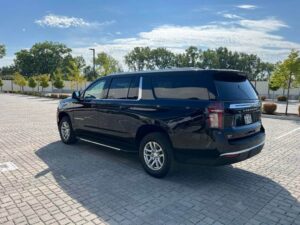
The luxury SUV is the right vehicle for most family airport trips. A collapsed double stroller typically fits in the rear cargo area alongside two to three pieces of checked luggage. A single stroller leaves room for a full family’s vacation packing. The SUV class also accommodates two car seats across the rear bench without the seat crowding that makes sedan rear-seat installation impractical for longer trips.
For multi-generational travel — grandparents plus grandchildren, or two family units traveling together — contact us for van arrangements. Those trips require coordinating passenger counts, mobility needs, and luggage volume in a single booking.
Car Seat Math — What to Confirm Before You Book
Three categories of child restraint cover the full age and size range from infant through elementary school. When you book family airport transportation in Chicago, the type you need determines what to request.
Rear-facing infant seat handles newborns through roughly 12–18 months (seat-model dependent). Rear-facing is the safest orientation for infants and is required by Illinois law for children under 2 unless they have already exceeded the weight or height threshold (see the Illinois law section below).
Forward-facing convertible seat covers the transition out of rear-facing through approximately 4–5 years, when the child outgrows the forward-facing harness weight limit of the seat (varies by model; typically 40–65 lbs). This is the seat parents bring from their own vehicles most often because they know their child fits it and it’s already adjusted.
Booster seat (high-back or backless) serves children roughly 4 years through age 7, pairing with the vehicle’s own lap-and-shoulder belt. Illinois law requires appropriate restraints through age 7 (under-8 mandate — see below).
When booking, specify your child’s current age and approximate weight. A professional chauffeur service confirms the appropriate seat type and ensures it is installed before pickup — not after you arrive. Bring-your-own is always an option and often the most practical choice for families who travel frequently and trust their own installed seat’s fit.
Booking lead time: Request car seats at least 24–48 hours before your pickup. Same-day car seat requests cannot always be accommodated. For holiday and peak-season travel (Memorial Day weekend, Thanksgiving, Christmas/New Year, spring break), book the seat arrangement at least one week ahead.
Illinois Child Safety Seat Law — What It Requires
Illinois law governs child restraint requirements for passenger vehicles under the Child Passenger Protection Act (625 ILCS 25/). The key thresholds, verified against Illinois Department of Transportation guidance:
- Rear-facing required: All children under age 2 must ride rear-facing, unless the child already weighs 40 or more pounds or is 40 or more inches tall.
- Child restraint system required: All children under age 8 must be secured in an appropriate child restraint system — car seat or booster seat as appropriate for size.
- Booster seat rule: Booster seats must be used with both a lap belt and a shoulder belt. A vehicle with lap-only belts does not support a booster seat legally or safely.
- After age 8: Standard seat belt applies. Children under 8 should stay in a booster seat until the vehicle’s seat belt fits correctly across the shoulder — typically when a child reaches approximately 4 feet 9 inches tall.
- Penalties: $75 fine for a first violation; $200 for subsequent violations.
One note on for-hire vehicles: Illinois law addresses child restraints in “passenger vehicles.” Whether limousines carry the same statutory obligation as private vehicles involves legal interpretation this guide cannot resolve. What every reputable chauffeur service recommends — and what we recommend — is using appropriate car seats regardless of any possible commercial vehicle interpretation. The child’s safety is not a legal question.
What Rideshare Gets Wrong for Families — The Cost Comparison
Rideshare pricing for a solo traveler to O’Hare runs roughly $40–65 from central Chicago neighborhoods at standard demand. That number changes for families in ways the app doesn’t surface until checkout.
Four passengers trigger the automatic upgrade to a larger vehicle class on most platforms, which carries a higher base rate. Add a car seat option (where available) and the surcharge increases further. Apply a 2× surge multiplier — routine during morning peak travel, holiday weekends, and bad weather — and a family-of-four airport run from Chicago’s North Side can reach $130–180 before tip.
More critically: rideshare car seat availability in Chicago is limited. The dedicated car seat options on major platforms typically provide one forward-facing seat per booking. That covers a four-year-old, not a two-year-old plus a six-year-old simultaneously. Families traveling with multiple children at different developmental stages either bring their own seats (which the driver may or may not have trunk space for, and which the driver is not trained to install) or accept a trip without appropriate restraints.
A flat-rate SUV booking covers the same O’Hare run for a confirmed rate at booking — no surge multiplier, car seats confirmed and pre-installed, vehicle size appropriate for the family. For more on how the full comparison works, read our breakdown of black car vs rideshare with kids.
Stroller Storage, Diaper Bags, and Vacation Packing Math
A double stroller collapses to roughly the footprint of a large suitcase for most side-by-side models; inline (tandem) strollers collapse significantly narrower. Either fits in the rear cargo area of a standard SUV alongside carry-on-size bags.
What does not fit: a collapsed double stroller plus three full-size checked-bag equivalents plus two backpacks in a sedan trunk. The math requires an SUV or larger.
Practical packing points for families:
- Gate-check your stroller at the departure gate, not at baggage drop. Gate-check bags come back to the jet bridge on arrival — you have the stroller before you reach baggage claim.
- Diaper bags and kids’ carry-ons travel in the cabin. They do not count toward the trunk math.
- TSA requires car seats to be screened separately from strollers — factor this into your pre-flight time budget.
- Families with an infant in a baby carrier still need trunk space for the stroller frame. Count it even when the child is worn.
Early-Morning Departures With Sleepy Kids — The 4 AM ORD Reality
O’Hare domestic departures with the lowest airfare tend to cluster in the 6–7 AM window. That means families are calling for pickup at 3:45–4:15 AM to clear security with adequate buffer. At that hour, rideshare pool depth is thin in most Chicago neighborhoods, surge probability is high, and the car seat option is effectively unavailable.
A pre-arranged family airport transfer eliminates the 4 AM uncertainty. The chauffeur confirms the pickup window the evening before. The SUV arrives at your door with the car seat already installed and temperature regulated. You load the gear, settle the kids, and the driver handles navigation, toll routing, and the commercial vehicle staging at ORD — while you manage the humans in the back seat.
One less variable at 4 AM is worth more than the price difference from standard rideshare.
Late-Night Arrivals When the Kids Are Done
Inbound flights after 9 PM arrive at a terminal where children have been in motion for the better part of a day. By the time the family clears the gate, collects bags, collapses the stroller, and reaches the ground floor, the tolerance for waiting in a rideshare queue is zero.
A professional chauffeur monitors your inbound flight in real time. When the flight delays 45 minutes, the pickup window shifts 45 minutes — no app re-booking, no surge penalty for the delay, no missed window. The complimentary wait time for arrivals covers the standard arrival window; late-arriving flights are absorbed without additional charge.
For families: the chauffeur is staged at the commercial vehicle pickup zone when you exit baggage claim, not 8 minutes away in a parking structure. You walk out, load, and go.
Multi-Generational Travel — Grandparents, Grandkids, and Group Sizing
A trip that includes grandparents and grandchildren introduces vehicle accessibility as a factor. Standard SUVs have a higher step height than sedans — this matters for elderly passengers with limited mobility. For groups that include both young children and older adults, confirm vehicle accessibility when booking and ask about step height.
Multi-generational travel also changes the passenger and luggage math significantly. Six passengers traveling together typically produce more total luggage than two families of three traveling separately, because group trips often pack for shared gear (beach equipment, portable cribs, activity supplies). Count bags at booking, not at curbside.
For large multi-generational groups, splitting across two vehicles may be more practical than attempting to fit everyone into one SUV. Two coordinated bookings with the same departure window cost less per vehicle than a single oversized van and provide more loading flexibility.
For professional O’Hare chauffeur service for families, we coordinate multi-vehicle bookings under one reservation.
O’Hare Terminal 5 International Arrivals With Kids
Terminal 5 at O’Hare processes international arrivals and their Customs and Border Protection (CBP) screening before passengers reach baggage claim. The customs queue is the single most variable element in a T5 pickup — and it is highly variable.
For US citizens using CBP’s Automated Passport Control (APC) kiosks, the queue moves faster than the standard officer lane. For families with young children traveling on US passports, APC is available. Children under 16 traveling with a parent process together on the parent’s APC entry.
For international visitors or non-US passport holders, processing through the standard officer lane can run 30 to 90 minutes depending on flight bank, staffing, and total international arrivals in the queue at that moment.
A professional chauffeur for international family arrivals builds the customs window into the staging plan. The clock does not start on complimentary wait time at wheels-down — it starts when the chauffeur has reasonable confirmation the family has cleared baggage claim. For a full walk-through of O’Hare terminal logistics and the T5 arrival flow, read the O’Hare arrivals walk-through.
Coordinating With the Airline — Lap Infants vs Ticketed Children
A lap infant (a child under 24 months traveling without a purchased seat) changes the boarding sequence and the car seat logistics.
On the airline side: lap infants board with their parents during family boarding, which happens before general boarding. This means the family actually has more time on the plane at departure — not less. Gate-check the stroller at the departure gate for the most convenient retrieval on arrival.
For the car seat: a lap infant traveling without a purchased seat is not restrained during the flight. A responsible transition to ground transportation means the car seat is the first restraint the infant is placed in after the flight. This is the argument for having the car seat pre-installed and immediately available at the pickup zone, not assembled at the curb.
Ticketed children (those with their own purchased seat) can bring an FAA-approved car seat onboard and use it during the flight, then check it at the gate for ground transportation use on arrival. Confirm with your carrier which car seats carry FAA approval.
Multi-Airport Vacations — When the Trip Combines ORD and MKE
Some vacation routings fly into one Chicago-area airport and return via another — typically combining O’Hare and Milwaukee Mitchell International (MKE), which is a Southwest Airlines hub and often prices lower than ORD for the same destination.
A family flying outbound from ORD and returning to MKE needs two separate ground transportation bookings: one departure transfer to ORD from home, and one arrival transfer from MKE back home. Both are straightforward flat-rate point-to-point transfers.
For families combining both airports in one trip, book the return leg from MKE at the same time as the departure from ORD — availability for car seat-equipped SUVs during peak travel windows fills faster than standard transfers. For Midway airport transfers or Milwaukee airport pickup, both can be arranged under a single account.
Kid-Friendly Chauffeur — What to Expect and What to Ask
A chauffeur working a family airport transfer operates at a different pace than a business pickup. Families take longer to load. Children need help with seat belts. Strollers require trunk assistance. The chauffeur who handles this well does not rush the family, does not make them feel slow, and does not create a stressed environment inside the vehicle.
When booking, it is reasonable to note that you are traveling with young children and ask about the chauffeur’s experience with family transfers. Questions worth asking: Does the chauffeur install the car seat, or does the family? Does the vehicle have rear-seat climate control? Is there a charging port in the rear seating area for entertainment devices on a longer pickup?
What not to expect: a child entertainment system in a standard SUV, or any equipment beyond the vehicle’s standard appointments and the confirmed car seat. What you should expect: a calm, patient professional who is there to get your family to the airport without adding to your stress.
Special Needs and Autism-Friendly Airport Transportation
For families traveling with children who have sensory sensitivities, autism spectrum differences, or other special needs, the airport transportation environment itself is a controllable variable — even when the airport is not.
A professional chauffeur service accommodates these needs when briefed in advance. Practical requests that are reasonable to make at booking:
- Request a quiet ride (no radio unless the family wants it)
- Request that route changes or delays be communicated calmly and explicitly (“we’re taking the express lanes — we’ll be there in 12 minutes”) rather than without notice
- Confirm the pickup sequence in advance so the child knows what to expect
- Note any specific triggers or requirements in the booking so the chauffeur is briefed before arrival
How Far Ahead Families Should Book
Families plan further ahead than business travelers — and that planning window matters for car seat availability specifically.
Standard booking lead time for a family transfer with a car seat: 24–48 hours minimum for the car seat request to be confirmed and prepared. Same-day booking is possible for the transfer itself; the car seat component may not be available on short notice depending on current inventory and scheduling.
For peak travel periods — the Memorial Day-to-Labor Day summer window, Thanksgiving week, the Christmas-to-New-Year stretch, and spring break weeks in March — book with at least one week of lead time for any transfer that requires a specific car seat type. Two weeks is better for holiday week pickups when demand is highest.
Families booking a vacation six to eight weeks ahead should lock the airport transfer at the time of booking, not in the week before departure.
Booking Your Family Airport Transfer — How It Works
The process is straightforward:
- Select vehicle size based on passenger count and luggage. Two adults, two children, a double stroller, and three checked-bag equivalents = SUV.
- Note car seat requirements in the booking: child’s age and approximate weight for each seat needed. Specify rear-facing, forward-facing, or booster as you know it.
- Confirm the quote — flat rate stated at booking with no surge multipliers, tip guidelines clear, no surprise fees at pickup.
- Receive booking confirmation with chauffeur assignment and pickup instructions.
- Day of travel: chauffeur monitors your flight in real time. For airport arrivals, the chauffeur stages at the commercial vehicle pickup zone and sends a text when ready.
- Load and go. Car seat is pre-installed. Trunk space is ready for the stroller. The family gets in, buckles up, and the route is already mapped.
For Chicago airport SUV service for families, contact us to confirm availability and request your car seat type. International arrivals from T5 — include your flight number at booking so the chauffeur accounts for the customs window.